Wearable biofeedback tool · In discussion with TU Delft
I·O
Perception & Context

The Body Compass

Feel sooner. Choose sooner.

Many people notice that their body responds to tension or triggers before their consciousness does. Heart rate changes, breathing accelerates — often before someone understands what is happening.

The Body Compass is a small, portable device that measures body signals and provides subtle feedback when the nervous system becomes activated. No warnings, no alarms — but a gentle breathing rhythm, a calm vibration, a pulsating light that invites regulation.

The goal is not diagnosis. The goal is: feel sooner, be able to choose sooner.

Status Concept — in discussion with TU Delft
IVO Biofeedback Systeemoverzicht

Measured signals

HRV

Heart rate variability — indicator of autonomous regulation and stress level.

GSR

Skin conductance — indicator of emotional activation and stress response.

Adem & Beweging

Breathing rhythm and activity — indicator of arousal and regulation.

Coupling with IVO

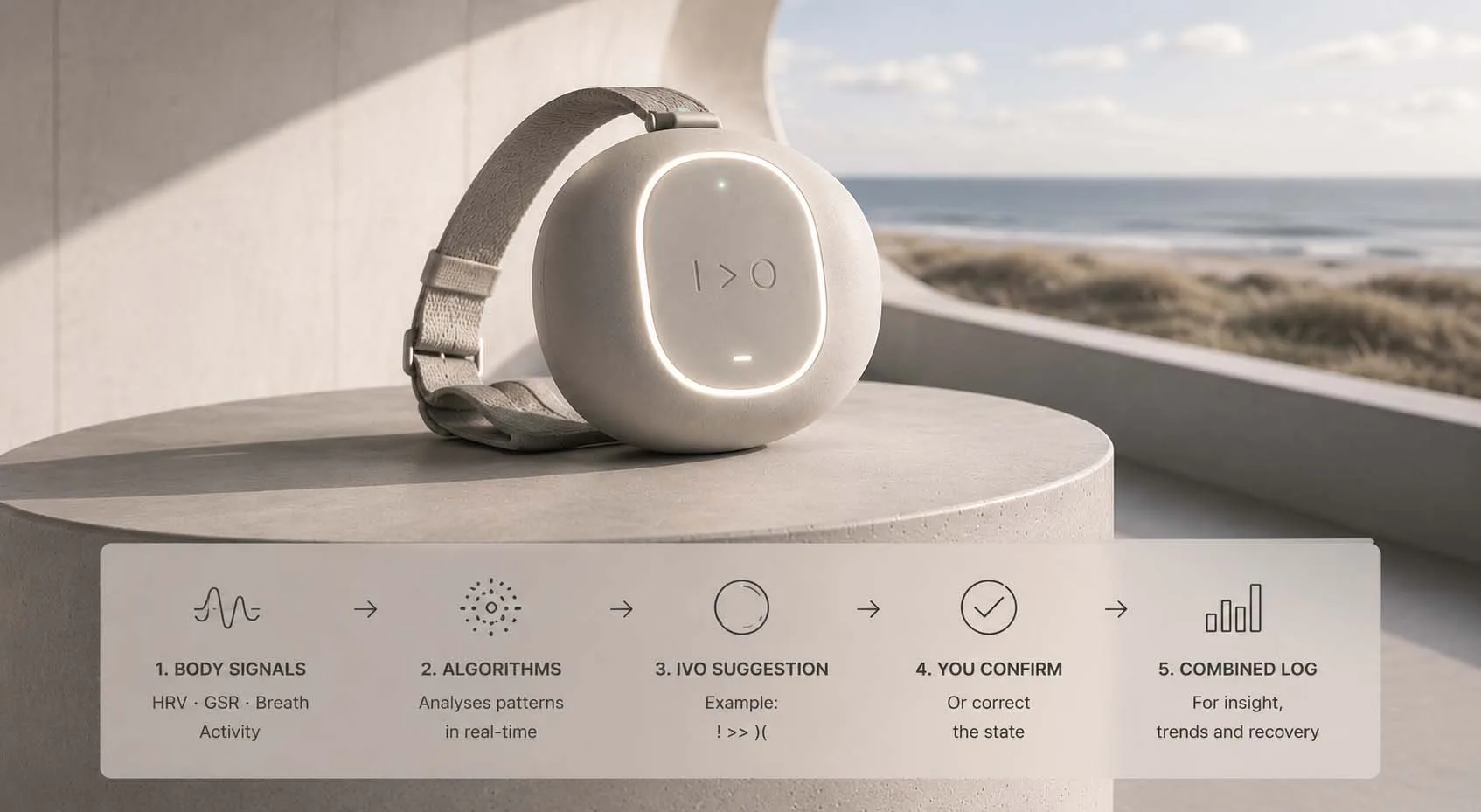
The innovation lies in the coupling with the IVO State Protocol. The device suggests an IVO state based on physiological data. The user confirms or corrects. That combination of objective measurement and subjective confirmation is the core.

Body signals
Algorithm
State suggestion
Confirmation
Combined log

Objective + subjective = personal system map over time

Design principles

Simplicity over data

A small number of signals, clear feedback. No dashboards during the day.

Calm feedback

Never alarming, always inviting. The device asks — it does not shout.

Co-design

Designed with people with lived experience — not for them. Their knowledge is in the design.

Stigma-free

No labels, no diagnoses. Only structure — in the language of I·V·O.

Wearable

Not only in therapy rooms. In daily life, on the ship, at work.

Open protocol

Built on the open IVO State Protocol. Connectable with other systems and research.

Collaboration in discussion

The Body Compass is being developed in collaboration with TU Delft and GGZ Delfland. The pilot involves 10–15 participants who log daily IVO states while wearing the device. The data — both subjective and objective — are compared for correlations and patterns.

TU Delft — Faculty of Industrial Design Engineering GGZ Delfland
Applications
GGZ & Recovery Lived expertise Self-regulation Research Wearables Sail for Recovery Team development Coaching

Think along, participate or finance?

info@design-by-authenticity.org